第四篇 抛投与摆速:Spey 谱系与 mend 体系
从 Fitzgibbon 到 Skagit:横漂的抛投工具箱,以及摆速控制五手段与 hang down
湿蝇的一切最终都落在两件事上:你能不能把线送到该去的地方,以及毛钩能不能以正确的速度横过水流。前一件是抛投,后一件是线操控(line control)。这一篇把这两件事拆到底——从 Spey 谱系的历史与分类,到 mend 的力学,再到摆速(swing speed)的五种控制手段与摆动末端的 hang down。
先给出全文的一句话前提:湿蝇的抛投与线操控,目的和干蝇、若虫相反。干蝇要的是松弛(slack),湿蝇要的是张力(tension)。 下面所有的技术选择,都可以从这一条推出来。
十四、抛投与线操控:与干蝇相反的目的
14.1 抛投目标:落水即进入张力
干蝇抛投追求可控的松弛,湿蝇抛投追求即时的张力。 Madison River Outfitters 的 Mike Loebl 把这条原则说得最直接:「The leader must straighten out fully on the cast. This allows the fly to begin to fish under tension immediately.」——leader 必须在抛投时完全展开,让毛钩落水后立即处于张力下作钓。他并补一句:与干蝇不同,湿蝇抛投几乎不需要松弛,「so it is important to cast a nice straight line」(抛出一条笔直的线很重要)。
Gink & Gasoline(Louis Cahill)从 Spey 的角度说了同一件事:「A good Spey cast delivers a nice tight loop which allows the entire system, fly, leader, head and running line to land on the water at the same time. When this happens, the swing is instantly under the angler’s control.」——紧致的抛投环让毛钩、leader、head(线头)与 running line(尾线)同时落水,此时摆动的速度立刻落在钓手掌控中。
这条「同时落水」的要求顺带解释了湿蝇抛投的多数故障:问题通常不出在距离,而出在系统落水顺序。 只要 head 先落、毛钩后落,水流就先抓住了线,等你拿到控制权时 belly(腹线)已经成型(见 16.4)。
14.2 Reach cast(伸展抛):落水之前就完成的预置 mend
Reach cast 在湿蝇体系里的定位,是一个「落水前就做完的 mend」。 Loebl 的用法几乎是全部:「Most of my casts while swinging wets are reach casts. This helps to slow the initial part of my swing and saves me from making mends once my flies are on the water.」——他摆湿蝇时大部分抛投都是 reach cast,用来减缓摆动起始段的速度,并省掉落水后再补 mend。
同一段里他对多数钓者的观察值得抄下来:「Most folks I see fishing wets pay very little attention to how their rod position affects their swing speed and fly action. They cast and simply hold on.」——抛出去就握着不动。而「By mending, lifting, leading or following you can have a dramatic impact on how your fly fishes.」这一句其实就是本篇后半部分的目录:mend、lifting、leading、following,四个动词对应四种速度控制手段。
14.3 Curve cast(曲线抛):只能按「同源外推」处理
曲线抛的资料在湿蝇语境下非常少。我们找到的最具体说明来自 Mac Brown(自 1987 年起教学),他把曲线抛分为五类,并区分正、负两种曲线:
「Negative curve casts use very little rotation on the final delivery stroke — the rod points directly toward the target at completion and the underpowered loop falls in a curve. Positive curve casts use greater than normal force — the loop travels with excess energy that kicks into a curve at turnover.」——负曲线用极小的末端旋转,竿尖最终直指目标,动力不足的环落下成弧,呈现更柔和;正曲线用大于正常的力,环带着多余能量在翻转瞬间踢成弯,可伸入悬垂植被下方。用途则是「curving left, right, upstream, and downstream to achieve a drag-free drift around conflicting currents or to place the fly in positions a straight cast cannot reach」。
这里必须明确标注定位:我们没有找到任何专门讨论「curve cast 用于湿蝇摆动」的权威专文。 现有资料只到「曲线抛的一般定义与用途」这一层级,且其原生语境是无拖拽漂流(drag-free drift),与湿蝇的「要张力」正好相反。所以下面这段只能当作同类逻辑的外推,而不是某位权威如此教:
- 在身后有障碍、又需要把毛钩送到「直线抛投到不了的位置」时,曲线抛可以作为 reach cast 的极端版本使用——它的价值在于落水形态,而不是在于制造松弛;
- 湿蝇体系真正需要的是「落水后线组尽快对齐、并处于张力下」,因此正曲线(有力、紧致)比负曲线(柔和、松弛)更贴合湿蝇,这与它在干蝇里的偏好相反;
- 若你想认真学曲线抛,回到 Mac Brown 的原始教学按干蝇/若虫语境学,学成之后再自行移植——不要指望从湿蝇的文献里找到现成答案。
14.4 落水后的第一个 water mend
湿蝇的 mend(补线)与干蝇、若虫的 mend 目的相反。 Loebl 说得毫不含糊:「This is a different mend than I make while fishing dries or nymphs where I am trying to introduce slack to allow my flies to dead drift. When fishing wets the purpose of the mend is to realign the fly line in the current, rather than producing slack with my mends. If I do mend, it is only at the beginning of my swing.」——干蝇/若虫的 mend 是引入松弛以取得 dead drift;湿蝇的 mend 是把飞线在当前中重新对齐。要做,也只在摆动最初做一次。
他的落水后竿位是配合这个目的的:「I mend upstream and HOLD the tip of the rod upstream of my fly line as it swings.」——向上游 mend,并把竿尖保持在自己飞线的上游侧随摆动移动。
MidCurrent 把 mend 列为速度控制的第一手段,并给出方向与时机:「an upstream mend will momentarily reduce tension and slow the swing down, while a downstream mend will increase tension and speed the swing up. A big upstream mend allows the fly sink before coming under tension, whereas a downstream mend drives the line into a quicker arc.」时机则是「Make your mend early in the drift, right after the cast, for maximum effect on swing speed.」Discovery Fly Fishing 把它压成一句口诀:「One upstream mend = deeper drift. One downstream mend = faster swing.」
但「该不该 mend」在来源之间存在分歧,取舍如下。 MidCurrent 的 step-down 文章主张克制:「Not necessarily — mend only when the line belly indicates a problem. One purposeful upstream mend immediately after the cast is standard practice to set the fly’s position and speed. After that, additional mends should be deliberate corrections, not habitual motions.」——不必每竿都 mend,只在线腹(belly)显示有问题时做;抛后立刻一次刻意的上游 mend 是标准动作,之后的 mend 应是刻意修正而非习惯动作。过度 mend 会引入松弛、让毛钩抽动得不自然。Discovery 把「Over-mending」列入常见错误表,症状是「Lifts fly out of zone」(把毛钩抬离泳层),修法是「Mend once then let it fish」。Loebl 的立场与之完全一致(「只在摆动最初」)。
本篇取「抛后一次刻意的上游 mend」为正统做法,依据是三个独立来源(MidCurrent 的 step-down 文、Discovery Fly Fishing、Loebl/Madison River Outfitters)在此完全一致,且都给出了「过度 mend 会破坏游动」的机制解释。唯一例外是 16.3 的 feed mend:那是在特定水流条件下的追加手段,不是常规动作。
14.5 单手竿也能做 Spey 抛
「Spey casting」是一套抛法,「Spey rod」是一类竿,两者相关但可分。 Gink & Gasoline 专门强调过:「It is important to note that spey casting and spey rods are two ideas, separate but associated. You can make any spey casts with a single-hand rod. You can also make overhead casts with a spey rod.」
Loebl 在鳟鱼湿蝇里正是这么做的:「Even when fishing a single hand rod, I rarely make a back cast when swinging wet flies. Instead I commonly use touch and go single hand spey casts. These casts are quiet and very quick to get the fly back in the water.」——即使用单手竿,他也极少做后抛,而常用 touch-and-go 的单手 Spey 抛;理由是安静、且能很快把毛钩送回水里。对湿蝇而言,「快」不只是效率问题:摆动是逐步向下游推进的节奏,每次起线重抛都在中断「毛钩在水中」的时间,单手 Spey 抛把这段空窗压到最短。
十五、Spey 谱系:从 River Spey 到 Skagit
十五、Spey 谱系:从 River Spey 到 Skagit
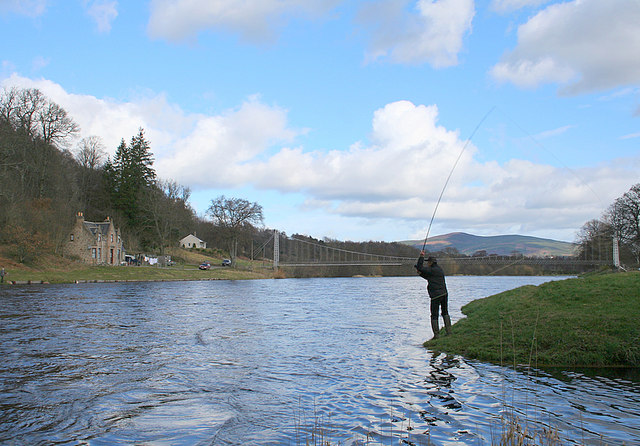 图:River Spey 畔 Aberlour 水域作钓的鲑鱼钓手。图:Des Colhoun/CC BY-SA 2.0(geograph.org.uk,Wikimedia Commons)
15.1 得名,与它最初的名字
Wikipedia 的 Spey casting 条目交代了得名与地理条件:「The name “spey cast” comes from the river Spey in Scotland, where this style of casting was popularized due to the river’s large width and difficult river bed footing (fishers are mostly unable to wade out into the river).」同条并指出它最初不叫这个名字:「This style of casting originally went by the name of the under-handed cast.」——引据是 Colquhoun 1849 年的《Rocks and Rivers》。
记住「under-handed cast」这个旧名,它对理解 15.6 的 Scandi 体系很关键:今天被当作一种「风格」的 underhand,其实是这门抛法的原名。
15.2 文献链:Fitzgibbon、Francis、Kelson、Taverner
Art Lingren 的《The Spey Cast or Welsh Throw》是本文找到最完整的梳理。「It was first mentioned in The Book of the Salmon (1850) by Edward Fitzgibbon, who wrote under the pen name of Ephemera. He said that in the Spey or Welsh throw, the fly is first to touch the water.」——1850 年 Fitzgibbon 首次提及,且记下一个关键特征:毛钩先触水。但「in Fitzgibbon’s book there is not enough information about this particular cast from which one could learn the mechanics to perform it」——资讯不足以据以学会。
第一个尝试描述力学的是 Francis Francis(《The Field》主编之一):「Francis Francis was one of the more distinguished editors of The Field and it was Francis who made the first attempt to describe the mechanics of the Spey or Welsh throw.」他给出的定义性描述(A Book on Angling, pp. 325–6)是:这是一种在「there are high banks or rocks at the angler’s back, so that he cannot send his line behind him」(身后有高岸或岩石、无法把线送到身后)时使用的抛法。同文并指出名称的多元——Francis 在脚注里说「This cast is called by various names; sometime ‘the Welsh or Spey cast’, or according to the name of some other river where it is practiced.」
这里有一处必须交代的文献分歧。 MeatEater(Kubie Brown)写的是力学首见于「an 1853 article of The Field by famous British fishing writer Francis Francis」;而 Lingren 记录的是《A Book on Angling》pp. 325–6。两说在载体与年份上不一致,本篇不裁决具体出处,只取两说共同的安全表述:1850 年 Fitzgibbon 首次提及,Francis Francis 首次系统描述力学。 至于是在《The Field》还是在《A Book on Angling》,留给需要精确引注的读者自行回查。
后续的文献链是清楚的:Eric Taverner 在 1931 年《Salmon Fishing》中把功劳归给 1895 年《The Salmon Fly》的作者 George Kelson——「Kelson devotes 40 pages to the different casting techniques of the day, with 15 pages on Spey casting」(40 页谈当时的各种抛法,其中 15 页谈 Spey casting)。Kelson 关于这门抛法核心的一句原话是全文最好的一句总结:「the great thing in this cast, the pure essential part upon which it entirely depends, is to compel the line to strike the water after lifting it out instead of sending it back in the air.」——关键、也是它完全赖以成立的纯粹本质,是强迫线离水之后击打水面,而不是把它送到身后空中。
15.3 gillies 与 beat:这门技艺的社会条件
Spey 抛法不是在一个人的车库里成形的。《Trout and Salmon》的《Gillies of the golden days》记录了 19 世纪中叶的场景转变:「By the middle of the 19th century, the salmon-fishing scene was being transformed… visiting sportsmen discovered that, for a small charge, the lessees might let them fish with rod, line and fly.」
配套的人力密度今天看来惊人:「Delfur (on the Spey) fished five rods allocated to four gillies. Three rods got a gillie to themselves while the head gillie – Willie Main at that time – looked after the remaining two.」;「A century ago, George McCorquodale’s 13 miles of the Spey was typically fished with just three rods, each accompanied by a gillie.」而 gillie 自身的钓获战绩也被记下:Tulchan 的 John Cruikshank 一天 22 尾 Spey springer;1932 年 Dalchroy 产出 880 尾鲑与 grilse,五名 gillie 合计拿下 329 尾,其中 Flockhart 一人 101 尾。
North 40 给了 ghillie 的通俗定义:「Ghillies was the Scot’s name for a guide in that time. These Ghillies would be a manager of the beat, making the beat their home away from home.」——beat(河段)的管理者。Gotham Canoe 的作者回到 Spey 河 Laggan beat 实地钓鱼,记录了这制度今天的样子(「有点像个向导,但不完全是……大概会穿粗花呢或打领带」),以及节奏:「the fly swings slowly across the pool, you take two steps and cast again.」——毛钩缓缓摆过水潭,走两步,再抛。这一句其实就是湿蝇的全部节奏,从 19 世纪到今天没有变过。
15.4 竿与线:从 greenheart 到石墨
Wikipedia:「When spey casting was introduced, 22-foot (6.7 m) rods called the “Great Vibration” created by rod-maker Alexander Grant of Inverness were used. These rods were made of spliced greenheart, a heavy wood imported from British Guyana. Today, rods are only 12 to 15 feet (3.7 to 4.6 m) in length, and can toss a line up to 80 feet (24 m).」
关于历史长度,各来源给的区间并不一致,此处并列: Wikipedia 记 Grant 的「Great Vibration」为 22 英尺;Sea Run Cases 记「often reaching lengths of 18 to 22 feet」;Gotham Canoe 在 Spey 河的实地记录是「an 18- to 21-foot beast fashioned from greenheart, a hard wood sourced from Guyana」。本篇取「18–22 英尺区间」作为安全表述,并把 22 英尺的「Great Vibration」当作该区间的上端特例,而不是全时代的通用值。
材料的演进线索(Sea Run Cases):19 世纪末至 20 世纪初转向竹(bamboo);20 世纪中叶玻璃纤维(fiberglass)登场;1970 年代石墨(graphite)带来革命。(提醒:同一来源中关于「某大学 Spey casting 生物力学研究」之类的陈述我们未能找到可核查出处,本篇不引用。)
线的一侧有一段漂亮的回环。Lingren 记录 Bob Taylor 制作的 SSST 单锥线(Super Steelhead Single Taper)「is not a new concept」——因为「Alexander Grant of Britain was using something similar when making those magnificent 40, 50 and 60-yard switch casts with his Grant Vibration rods and single-taper lines around the end of the 19th century」,记录于 Jock Scott 1952 年的《Fine and Far Off》。19 世纪末的 40、50、60 码 switch cast,与我们今天讨论的长肚线(long belly)是同一件事的两个时间切片。
15.5 锚的两大族:touch-and-go 与 waterborne anchor
Spey 抛的本质是「用一段留在水面的线当锚(anchor),换取没有后抛空间的自由」。 Swing the Fly(Zack Williams)给出最清晰的两分:
- waterborne anchor casts ——「which make an initial move that positions the line and anchor on the water, where it will remain until the forward cast delivers the line towards it’s target.」(先有一个把线与锚定位到水面的初始动作,锚留在水面直到前抛送线。)
- touch-and-go anchor casts ——「which do not have that initial step placing the line on the water. Instead the line will be aerialized, then briefly “touch” the water to form the anchor before the forward cast.」(没有把线放到水面的初始步骤;线先在空中,然后短暂触碰水面形成锚,随即前抛。)
Wikipedia 用另一组术语表达同一分类:「the “splash and go” and the “waterborne anchor”」——splash and go 的后抛在空中,线落水后线尖一触水即开始前抛;waterborne anchor 的后抛留在水面,「there is no requirement to achieve perfect timing in order to forward cast after」(不要求完美时机)。JS-Outdoors 的术语表把 touch-and-go 与 Skagit 式 sustained anchor 明确对立。
第三类:sustained anchor(持续锚),即 Skagit 体系。 JS-Outdoors:「Sustained Anchor Cast - Skagit style cast. This cast is accomplished by presetting the anchor and then forming the D-loop on the second move.」同表并定义 Skagit cast 是「a sustained anchor style of casting, which uses a continuous motion throughout the sweep, turn up to the “key” position and then the forward stroke」,常被称为「Ed Ward 风格」。OPST(Ed Ward 所属品牌)自称「It is distinguished from other Spey-type styles of casting by its use of a casting mechanism known as the Sustained Anchor」,并把 Ed Ward 的创新列为 Skagit 线、激进短的沉尖、steelhead 沉尖战术与 Intruder 之类的毛钩。
为什么 Skagit 必须用持续锚?Fly Fisherman(Rick Kustich)的解释:「Heavy tips and weighted flies need a nearly continuous motion or “sustained anchor” throughout to keep everything at the surface and effectively complete the cast.」——重沉尖与加权毛钩需要近乎连续的动作,才能把一切保持在水面附近并有效完成抛投。
抛法与族别的对应(含来源分歧):
| 抛法 | Wikipedia | MidCurrent | JS-Outdoors |
|---|---|---|---|
| Single Spey | splash and go(touch-and-go 群) | touch-and-go | 双向抛,毛钩放上游侧;用于上游风 |
| Double Spey | waterborne anchor 群 | waterborne anchor/sustained anchor | 双向抛,毛钩放下游侧;用于下游风 |
| Snake Roll | 双动作抛,源自 Wales(旧称「snake-cast」) | — | 双向抛,毛钩放下游侧;用于下游风 |
| Snap-T | — | waterborne anchor/sustained anchor | 双向抛,毛钩放上游侧;用于上游风 |
| Circle C | — | — | 类似 Snap-T;可替代 Single Spey,上游风更安全高效 |
| Perry Poke | — | waterborne anchor(万能重置) | 可移植到任何抛法的线位移动 |
| Spiral Cast | — | — | Snake Roll 与 Single Spey 的组合 |
MidCurrent 对三者(Double Spey、Snap-T、Perry Poke)的补充是:它们都是 waterborne anchor,「meaning the fly stays in contact with the water during D-loop formation. This matters for winter steelheading because touch-and-go casts struggle to turn over the heavy sink-tips and weighted flies needed to reach fish holding deep in cold water.」同文并记 Snap-T「Developed by Pacific Northwest casters specifically for Skagit lines and heavy tips」,Perry Poke「Named for originator Karl Perry and championed by Skagit master Ed Ward」。Deneki(Whitney Gould)则指出 Scandi 线对应的是空中锚:「Scandi Lines… are a great line design for “airborne anchor” casts – casts such as the single spey and snake roll.」
一个术语陷阱: JS-Outdoors 开头就说「The primary styles of “two-handed casting” include spey casting and skagit casting, but both types of casting are commonly referred to as spey casting.」——行业里常把两者统称 spey casting。读到「spey cast」时,先确认对方说的是哪一族。
锚的判准(跨来源一致): Swing the Fly 说好锚做两件事——「1. They point at your intended target. 2. The provide the proper amount of water tension.」张力太少会听到「啪」的撕裂声,太多会听到「吸」声,「A good anchor is nearly silent.」(好锚几乎无声。)
锚位距离的取舍。 分歧是明确的:MidCurrent 说「Your anchor should land about one rod length away from you, positioned 45 degrees off your casting shoulder on the downwind side.」(约一竿长、离抛投肩 45 度、下风侧);Flylords 说「roughly one rod length away on your intended casting side (usually the downwind side so you do not hook yourself in the back of your head)」(约一竿长,且给了同样的安全理由);JS-Outdoors 说「The anchor should be one and a half rod lengths from the caster in front but off to the side (45 degree angle).」(一个半竿长、偏侧 45 度)。
本篇取「约一竿长、抛投肩外侧 45 度、下风侧」为工作基线,理由是 MidCurrent 与 Flylords 两个独立来源完全一致,而且 Flylords 给出了具体的物理理由(下风侧避免钩到自己后脑)。同时保留 JS-Outdoors 的「一个半竿长」作为长竿与重 head 的变体——竿越长、head 越重,D-loop 需要的空间越大,锚自然被推远。最关键的一层理解是:锚位不是一个校准值,而是一个随竿长、线重、抛法浮动的范围;判断标准回到 Swing the Fly 那两条——指向目标、张力适中、几乎无声。
15.6 Scandi、Skagit 与长肚线:三种头的分工
三种线头的分工,是「以质量推动质量」这句口号的具体化。 Deneki(Whitney Gould)说得直白:「it takes mass to move mass… There is more mass in an equally sized Skagit head than that of a Scandinavian style heads.」
长度与结构(Fly Fisherman, Rick Kustich):「A Skagit line setup is comprised of a very short head only 25 to 35 feet in length. This is often combined with an 8- to 15-foot section of sink tip for a total head of 35 to 45 feet.」;「A Scandi head has a much longer and smoother front taper than a Skagit head… Scandi heads are typically 30 to 45 feet in length and require a 12- to 15-foot light tip or leader in order to establish an anchor point.」;长肚线则是「Medium to long-head lines fall into a range of 50 to 75 feet in length and are characterized by a gradual taper capable of creating a tight casting loop to propel the head.」MidCurrent 对 Skagit 长度的说法略短(「typically under 30 feet」),RIO(Simon Gawesworth)2020 年的产品数据里 Skagit Max Short 是 20 英尺、Skagit Max 是 23 英尺,Scandi Short Versitip 是 32–33 英尺。本篇不裁决具体数字,取「Skagit 约 20–35 英尺、Scandi 约 30–45 英尺、长肚 50–75 英尺」的区间表述。
锚的触感差异(Mark Bachmann, Fly Fish USA):「Whereas both the Skagit and traditional cast have a hard anchor on the water, a Scandi anchor is more of a soft kiss. In its purest form, a mere touch of the fly upon the water is a sufficient anchor with a Scandi cast.」——Scandi 的锚更接近轻吻,最纯粹时毛钩仅触及水面即可。同文并给出 D-loop 的差异:「The Scandinavian cast ordinarily uses a longer, narrower D-loop than the Skagit cast.」以及调性差异:「In the beginning, Scandinavian rods were stiffer and faster action than Skagit rods, which are actually fairly “traditional action.” … The Scandi rods store the most power in the tip of the rod, while Skagit rods concentrate power lower into the butt.」
与摆速的对应关系(本篇最关心的一栏): Bachmann 说,钓 steelhead 时「the Scandinavian method fishes the fly downstream at a steep angle that brings the fly across slowly on a steady predictable course. The Skagit method often presents the fly more across-stream, or even slightly upstream, then the fly is allowed to drift and sink before coming under full tension.」——Scandi 走陡的下游角、缓慢稳定可预测;Skagit 更跨流甚至略偏上游,先漂流下沉再进入全张力。North 40 的利弊清单则给出了另一面:Skagit「is clunky. It takes a lot more energy to lift and cast the line. This brings the fly down at a rate that has a lot of eruptive impact when it hits the water - potentially spooking a wary fish.」,Scandi「the presentation can be very delicate, giving your fly a wonderful kiss when laid out with a smooth cast」,但「you cannot cast big heavy flies」。Discovery Fly Fishing 的实用结论是:Scandi 用于夏季较轻的呈现,Skagit 用于冬季水流中翻转重毛钩与重尖。
长肚线在「摆速控制」这件事上有一个被低估的优势,MidCurrent 专门指出:「That longer head keeps thicker, heavier line outside the rod tip, which is one reason Spey systems excel at mending and swing control at distance. A Skagit head, on the other hand, concentrates most of its weight into a short segment and relies on shooting running line for distance. Once your thin running line is on the water, meaningful mending becomes harder.」——细尾线一旦落水,有效的 mend 就变难了。 North 40 给长肚线记的优点正是「It allows you to cast 54 to 70 feet at the drop of a dime… The long bellies swing through runs very smoothly, crisply, and are easy to control during your swing」,缺点则很诚实:「Windy days suck!」,外加线扭(line twist)与尾环。
Scandi 的来路(FFI《The Loop》):「The underhand cast was developed by Loop Tackle Design’s, Göran Andersson, to assist him when fishing difficult waters in Scandinavia. Often severely limited casting room and the need for heavy sinking lines made conventional long-line speycasting extremely difficult. Andersson developed a method of speycasting short shooting heads (30 ft - 45 ft) which dramatically reduced the amount of rear clearance required for casting.」——回到 15.1 的旧名,underhand 就是这门抛法的原名,Andersson 做的是把它与短 shooting head 结合。轻量化的幅度(同文):「A typical long-bellied weight 11 spey line for an 11-weight rod might weigh 900 - 1000 grains, while a modified shooting head for the same rod would come in around 450 - 500 grains.」
关于 Andersson 的技术成形年代,本篇采取降级表述。 flyfishing.online 给出「In the 1950s the Swede Göran Andersson began to stop the rod consistently earlier」,但此年代仅见该单一来源;FFI 的《The Loop》只说他为斯堪的纳维亚的困难水域开发此法而未给年份,EFFA 的人物页也只称他为「father of the underhand technique (Andersson technique), inventor of the shooting head, and the Large Arbor Reel」。因此本篇只说「成形于 20 世纪中叶、并随更快的竿与商品化的 shooting head(由瑞典 LOOP 推出,Andersson 为共同所有人)而定型」,不把 1950 年代写成确定事实。
Skagit 的来路: North 40 列出的开发者是「Scott O’Donnell, Ed Ward, and Dec Hogan」;OPST 以 Ed Ward 为 Skagit 相关创新的代表人物;Kustich 则回忆在商品化之前「I used an overlined pike taper to do exactly that」。命名逻辑(Bachmann):「The main areas where this revolutionary thinking and technological change happened was on Scandinavian salmon rivers and in steelhead rivers of the Pacific Northwest of North America, hence: Scandi for Scandinavian and Skagit named after the Skagit River.」
配重要按 grain 而不是竿号。 Gink & Gasoline 解释了原因:「The action of any rod is greatly affected by the weight of the line it casts. This is never more true than with spey rods. That’s why the line systems used are sold by grain weights rather than rod weights.」Kustich 给的经验法则是「A rod generally handles a short head that is three times the rod length」,并提醒长 head 配长竿(他本人用 13–14 英尺竿配中长 head)。实际数字上,ECHO Fly Fishing 2022 年的双手线建议表(grain 按「维持锚定时竿尖之外的线量」计算,若用于过头抛建议比表列少 60 grains)是很好的锚点:
| 型号 | 长度 | 竿号 | 建议 grain 区间 | 建议值 |
|---|---|---|---|---|
| SR 3106 | 10’6” | 3 | 150–210 | 210 |
| SR 4106 | 10’6” | 4 | 210–270 | 270 |
| SR 61010 | 10’10” | 6 | 330–390 | 360 |
| SR 71010 | 10’10” | 7 | 390–450 | 450 / 420 |
Kustich 的切身数据可以对照着看:「My favorite 8-weight rod balances with a 540-grain Skagit head, and with a 450-grain Scandi.」他也提醒线盒上的竿号未必可信:「an 8-weight two-handed rod may comfortably handle a 540-grain Skagit head but also handle a 600- to 700-grain medium- to long-head line. The line might not even say “8-weight” on the box.」
15.7 switch rod:定义争议与取舍
长度是唯一有共识的部分,但共识的边界本身有分歧。 Gink & Gasoline:「A switch rod is quite simply a two-hand rod, which is shorter than 12 feet six inches.」并界定 Spey rod 为「12 feet six inches or longer, with upper and lower grips」。JS-Outdoors 的划分更短:「Switch Rod - Two-handed rods that are between 10’ and 12’」;Fly Fisherman(Kustich)给的是「generally 10.5 to 11.5 feet」;MidCurrent 在小河水摆动里建议「a switch rod (10’6”–11’6”)」;Wikipedia 给双手竿的总体区间是 10’6”–16’。本篇取 Kustich 的 10.5–11.5 英尺为主区间——它落在上述所有区间的交集里,且同一作者给出了适用场景:「most often used for Spey fishing and have the greatest application on smaller to medium rivers, or when fishing confined areas with only limited space for forming a casting loop.」
「switch」是长度定义,不是调性定义。 Gink & Gasoline 对此有明确立场:「Regardless of our feelings, there is an agreed technical definition and it is length, so I’m sticking to that.」同一作者也点破这类竿的代价:「The switch rod is a true “jack of all trades” and, as the saying goes, “master of none”. There is an inherent compromise at work in switch rods.」针对不愿妥协的钓者,近年的解法是 micro spey——「These rods are essentially switch rods, without the switch. With these rods, rod designers returned to more traditional actions, which favor two-hand spey casting.」(Winston 等厂);Sea Run Cases 另记 trout spey「typically ranging from 10 to 12 feet」,用更小的毛钩与更轻的线做 Spey 式抛投。
关于 switch rod 的起源年代,本篇采取降级表述。 Gink & Gasoline 称「Switch rods were born around the 1970s and took a while to catch on.」,但此年代仅见于该单一来源,我们未找到第二个独立佐证。 请把「1970 年代左右」当作一个待考的通行说法,而不是定论。
15.8 20 世纪北美的再引入
Lingren 亲历了这段:1980 年代初,「most steelhead fly fishers used rods of 9 to 9 1/2 feet with either a shooting head system consisting of a 30-foot long sinking line attached to a running line or weight forward floating lines.」——9 到 9.5 英尺竿配 30 英尺沉水 shooting head,或 WF 浮水线。
转折点在 1985 年 10 月 5 日上午 10 点:「a dozen or more double-hand rod Spey casting enthusiasts gathered on the banks of the Stave River below Ruskin Dam and I demonstrated Spey casting the 17’-6” Bruce & Walker, the 15’ Orvis and 12’ Bruce & Walker.」这就是第一次 Speyclave。教材的传播紧随其后:1986 年 2 月 24 日「17 Totem Fly Fishers packed into my recreation room for that first viewing… Falkus’ video was one of the most popular items in the fledgling Spey casting community and it more than anything previous helped many learn the single and double Spey casts.」;1987 年「Mike Maxwell produced the first North American Spey casting video with accompanying instruction manual—Spey Casting: Controlled Energy Method.」
十六、Mend 体系:减速、喂线与 belly 管理
16.1 上游 mend 的减速机制
mend 是摆速控制的第一手段,机制是张力。 MidCurrent:「In simple terms, an upstream mend will momentarily reduce tension and slow the swing down… Make your mend early in the drift, right after the cast, for maximum effect on swing speed.」Flylords 从 Great Lakes 的角度补了机制的另一半:「adding an upstream mend after completing the cast takes tension off the line and tip, allowing the fly to sink deeper before the swing.」——卸掉线与竿尖的张力,让毛钩在开始摆动前下沉更深。
这里要看清一条因果链:上游 mend → 张力降低 → 摆速下降 → 毛钩下沉更深。 深度不是被 mend 直接改变的,是被速度改变的。这条链是 17.4 裁决「角度与深度之争」的关键工具。
16.2 幅度:要移动的是整个 head
MidCurrent 的 step-down 文章把「幅度」单独拎出来强调:「execute one deliberate upstream mend that moves the entire Skagit head, not just the running line. This positions the fly as the leading element of the swing and sets the correct speed from the start.」——要移动整个 Skagit head,而不只是 running line。
Gink & Gasoline 给了一个可以当场检验的标准:「A good mend is one where the entire head is realigned. If you’ve made a good cast and a good mend, your fly should be the part of the system which is farthest down stream.」——若你抛得好、mend 得好,毛钩应该是整个系统中最靠下游的部分。这一条比任何图示都好用:落水后看一眼线形,就知道这次 mend 有没有做到位。
同文(《The Swing Is The Thing》)还给出一个反向思考——什么时候该在抛之前先走步:「In a typical run I will make my cast across the river, then throw a big mend and high stick as I step down and ease the fly into the swing. All of this is done to help the fly sink and control the speed of the swing.」相反地,「If you take your steps before you cast and quarter your cast downstream, your fly will ride higher in the water column because your swing starts immediately.」——先走步再抛,摆动立即开始,毛钩就浮在更高水层。
16.3 feed mend 与 stack mend:两种「给线」的办法
Stack mend(堆叠补线) 的定义来自 Brant Oswald:「Stack mending is the technique of introducing additional slack to a presentation, “stacking” this extra slack on a single line of current. The common applications of this mending technique are on downstream angles. A downstream stack mend is sometimes called feeding or “shaking” line, as slack line is shaken through the guides onto the current line with a flip of the rod tip.」技术要点则是:「When the cast is angled straight downstream (or nearly so), the tip is flipped vertically, so that the additional slack is deposited on the current directly beneath the rod tip. If the angle of presentation is not straight downstream, the tip is driven horizontally, so that the line can be moved onto a current line to the side of the caster.」操作上有两条关键:「have all of the needed line stripped off the reel before starting to shake the line through the guides… and to shake out a foot or two of slack line at a time」——开始摇线前先把线全部拉出卷线器,每次摇出一两英尺。 反面则是「Trying to feed line at a continuous rate, rather than flipping it out a chunk at a time, almost always creates enough tension in the line/leader/fly system to produce drag.」
Feed the mend(边补边给线) 是另一条路径(Living Fly Legacy):「The idea is that as the line is pulled up and rolled over for the mend, you let some additional line out. It has to happen as the mend is occurring though, mid-mend if you will. This will allow the mend to occur by taking line from you, rather than pulling the fly-tipped end back and out of the zone.」——在 mend 发生的中途同时放线,让 mend 靠「从你这边取线」完成,而不是把毛钩端往回拉、拉出泳层。
必须标注的适用边界:本文引用的 feed mend 与 stack mend 资料,其原生语境都是干蝇/若虫漂流,而不是 steelhead 的湿蝇摆动。 我们未能找到「feed mend 用于 steelhead swing」的权威专文。因此以上两条在湿蝇中的用法属于可控的移植:它们的价值在于「在摆动中追加松弛而不拉扯毛钩」,恰好对应 17.3 第 5 条(lead/follow)想达到的效果,但不要把它们当作湿蝇的标准动作来练——湿蝇的默认仍是 14.4 的「抛后一次刻意的上游 mend」。
同时要警惕哲学上的混用。Troutbitten(Domenick Swentosky)有一套非常完整的 mend 哲学:「So, mend as soon as the cast finishes. Even if the mend isn’t yet needed, mend anyway. Think of it as a setup mend. Then mend again, and again, and again, throughout the drift. I’d rather perform a series of short mends instead of one big mend that starts halfway through the drift.」他还强调 mend 的对象不只是飞线:「Many anglers seem satisfied with mending the fly line, but they miss what is more important — the leader.」以及动作要干脆:「Use rod tip movement that flexes the rod and forces energy into the mend. In this way, the power of the rod does the mending and not your arm.」
但请注意:这套哲学明确是为干蝇/若虫的 dead drift 服务的(原文的目标是「mends that provide slack to the dry or the suspender」),与湿蝇「mend 用来重新对齐、不制造松弛」(Loebl)目的相反。它的「不断再 mend」与 MidCurrent 的「抛后一次、其余为刻意修正」是两套体系,不可混用。可以借鉴的只有「竿尖动作要干脆、用竿的力量而非手臂」这一条动作质量要求。
16.4 belly 的读法:一个可量化的判据
Gink & Gasoline 是对 belly(线腹)形状讲得最细的来源。「The belly is the part of the line which is swept by the current causing an arch in the path of the line. When swinging flies the belly determines the speed at which the fly moves across the current.」——belly 决定毛钩横过水流的速度。
两种基本形态:
- 外凸 belly(convex):「Your line bellies down stream so that the middle of your line is down stream of your fly.」(线向下游鼓出,中段在毛钩下游。)
- 内凹 belly(concave):「Your fly moves down stream and hangs below your line, which curves to follow.」(毛钩往下游走并吊在线下方,线跟着弯。)
百分比量化(可直接搬到水上用):「Picture a swing where your line makes the shape of an L. Your fly and leader point in a direction perpendicular to your rod. We will call this a 90% belly. A 45% belly would have less curve in the line and a 100% belly would have more. A straight line swing or 0% belly would have no curve in the line.」
判读准则:「A good swing presents a convex belly of 90% or less. Any more than 90% and you’re not fishing. The closer you are to a straight line or 0% swing the better your chances of getting a fish. A belly that looks like a J with the line pointing up stream does not fish. The fly is ripped through the water so fast the fish will not waste the energy chasing it.」同文引述 Jeff Hickman 的一句更狠:「If your line is pointing up stream, you’re not in the game. If it’s pointing across the current, it’s a lottery. The further downstream it’s pointing, the better the odds.」
反向的失误是内凹 belly:「a concave belly isn’t a good thing. When the line curves out and down, rather than down and across, the fly moves too slowly and the angle presents only the tail of the fly to the fish.」——太慢,而且只有毛钩尾部对着鱼。
「樵夫症候群」(wood chopper’s syndrome) —— 造成 J 形 belly 的常见抛投故障:「A common problem is for the head to land on the water before the leader, fly and sink tip if you’re fishing skagit style. When this happens, the current takes the line downstream before the fly even lands. The J belly of over 90% is already in place when the angler gains control of the line.」成因则是「when the caster’s top hand moves forward during the casting stroke, creating a downward arch in the line. Remember, the casting stroke is powered by the bottom hand.」——抛投行程由下手出力;上手前送会造成线的下凹弧。 这正好回到 14.1 的「同时落水」:故障不是距离问题,是顺序问题。
16.5 belly 判据的一个推论:抛投角度的落点
Loebl 给出一条与 belly 直接挂钩的抛投法则:「a good rule is to cast close as you can to a 90-degree angle without the line bellying immediately at the start of the swing and minimal mending is required. Usually this ends up being a cast angled across and slightly down at an 80-65 degree angle.」——尽量接近 90 度抛,但不能让线在摆动一开始就鼓出 belly,且所需 mend 最少;实际常落在 80–65 度。 这句话是 17.4 角度讨论的入口,因为它把「角度」从教条变成了一个由 belly 反馈决定的变量。
再抛(恢复)工具:Perry Poke。 MidCurrent 描述它「deliberately dump the line in a pile on the water in front of you, pause, then sweep into a D-loop and cast… the line sits there while you reposition, breathe, or recover from a botched cast.」——刻意把线堆在你前方的水面上,暂停,再扫入 D-loop。它是一个「万能重置」:站错了、抛砸了、需要重新呼吸的时候,先堆线,再重来。
十七、摆速控制与 hang down:五手段、角度之争与摆动末端
17.1 为什么摆速是核心
Gink & Gasoline 把标准立在这里:「The key to a good swing is keeping the fly moving at just the right speed and angle. That buttery slow swing that gives the fish time to see the fly and react. The gentle motion that entices the attack. It’s a hard thing to visualize and even harder to describe.」并给了行业术语:「When the fly is swinging at a good pace and angle, we will say it’s fishing. Not fishing means the speed and angle are wrong.」——「在钓鱼」与「不在钓鱼」,判据就是速度与角度。 同文估算的浪费规模值得记住:「it’s pretty common for anglers to waste as much as half their fishing time with a poorly swung fly.」
一个来自 Troutbitten 的反面意见,作为对照而非否定: 「Swinging is arguably the easiest presentation on a streamer… We get more refusals with a swing than with most other tactics. We also average smaller trout to the net.」——摆动是最容易的呈现,但拒绝率更高、平均钓获的鳟鱼更小。这条意见的用途是校准期待:摆动不是「省力地钓大鱼」的捷径,而是一种覆盖效率高、需要靠摆速与角度精修来提高质量的呈现方式。
17.2 快摆与慢摆各自触发什么
MidCurrent 把机制说清楚了:「Speed and depth are closely linked in swinging presentations. Generally, a fast-swung fly will ride higher and shallower in the water, whereas a slower swing allows the fly to sink deeper into the fish’s zone.」——快摆高而浅,慢摆深而低。
水温决定该选哪一边:「In cold water, fish are lethargic and often hold near the bottom; they usually won’t chase a rapidly moving fly toward the surface. In those conditions, a slower, deeper swing is usually far more effective… In warmer water or when fish are aggressive, speeding up the swing or presenting the fly higher in the water column can grab attention.」反面同样成立:「A fly swinging too fast near the surface might not tempt fish holding deep, especially in cold water. Conversely, a fly that’s swinging very slowly and deep could be exactly what sluggish fish want; or a faster, shallower swing might provoke a reaction strike.」
一致性(consistency)是被反复强调的目标:「Experienced swing anglers often strive for an even, steady swing speed through the drift, believing it maximizes the chances of a take. If your fly accelerates or stalls abruptly, it may put off fish.」要做匀稳,MidCurrent 的办法是前段调整、末端放开:「Achieving that consistent swing often means making adjustments early in the swing (when the line is in faster mid-river currents) and then letting the fly speed up slightly in softer water at the end, so that the overall movement appears uniform.」
常见错误表里排在第一条的也是速度(Discovery Fly Fishing):「Swing too fast in cold water」——冷水鱼保存体力、可能不追快毛钩,修法是「Slow down swing with upstream mends」。同表还有一条**「Casting too far」——症状是「Creates drag and a fast, unnatural swing」(造成拖拽与过快、不自然的摆动)。「抛得更远」在湿蝇里不是美德**,这一点与干蝇/若虫的直觉相反。
17.3 速度控制的五种手段
MidCurrent 的归纳可以直接当作操作清单:
- mend 线:「an upstream mend will momentarily reduce tension and slow the swing down, while a downstream mend will increase tension and speed the swing up.」
- 改抛投角度:「Casting straight across (90 degrees to the current) means more of your line gets caught in fast water, so the fly will swing faster. Casting more downstream at a shallow angle results in a slower swing.」
- 移动脚步:「If you wade a few steps farther out into the river, you shorten the line distance between you and the fly, which in turn slows the swing because the current has less line to pull on.」
- 改竿尖位置:「Reaching your rod tip out high and toward the center of the river (especially with a long rod) can slow the swing by reducing drag. In contrast, pointing your rod tip low and toward the downstream bank will put more line in the faster current, creating a downstream belly and speeding up the swing.」
- lead 或 follow:「Keeping the rod tip trailing behind the fly (i.e. pointed a bit upstream of the fly’s position) puts a touch of slack in the system and slows the swing slightly.」
Loebl 的版本更经济,一句话就能记住: 「If I want to slow the swing, I keep the tip of the fly rod behind or outside of the line during the swing. If I want to speed things up I begin to lead my swing, pointing the rod tip slightly inside of the line to where the fly is headed. In fast water I slow things down, slow water I’ll speed things up.」——要慢,竿尖留在线的后方或外侧;要快,把竿尖「领」到线的内侧、毛钩将去的方向。快水放慢、慢水加快。
Gink & Gasoline 给了摆动起始段的具体动作:「To slow the fly down, keep the tip of your rod held high and pointed straight across the current. As the fly swings down stream, lower the rod tip and draw the rod closer to your body then slowly start to turn it down stream. This will keep the fly moving at a slow and tempting pace in the fast water.」Discovery 的两句口诀则适合贴在竿盒上:放慢——加大角度并加上游 mend 以延长摆动时间;加快——减小角度并加下游 mend 以缩短摆动时间。
17.4 角度:45° 基线与「哪种角度更深」之争
起摆角度的默认值,三个独立来源一致指向 45 度: MeatEater(Kubie Brown):「Typically you cast across the river at a 90- to 45-degree angle downstream, where the line is mended, and the fly sinks to the desired depth before being swung tantalizingly across the current.」;Wet Fly Swing(Dave Stewart):「The wet fly swing is implemented by casting downstream and across the river at a 45-degree angle. After making a cast, it’s good to make one mend to get your fly in proper presentation and speed.」;MidCurrent 的 step-down:「Maintain a consistent casting angle of roughly forty-five degrees downstream.」
但 45 度不是唯一答案,而是「摆动幅度」的一个取值: Discovery Fly Fishing 给的目标区间更宽(「Target your cast 30–60° downstream」),Loebl 给小水鳟鱼湿蝇的落点是 80–65 度(见 16.5)。本篇的裁决是:把 45 度当作基线与校准点,把 30–60 度当作可调范围,把 80–65 度理解为「小水、鳟鱼、以 belly 反馈为准」的另一种落点——三者的分歧主要来自水域尺度与目标鱼,而不是来自对错。同时,跨来源一致的一条关系不能忘:「The more across stream the cast is made, the faster the fly will initially fish. Casting downstream at a steep angle makes for a very slow swing.」(越跨流,毛钩初始越快;越陡的下游角,摆得越慢。)
至于「哪种角度更有利于钓深」,来源之间存在真正的矛盾,必须给出取舍。
- MidCurrent 的 step-down 文章持「更陡=更深」:「A steeper angle (more across-stream) slows the swing and lets the fly sink deeper — ideal for cold water below 42°F. A shallower angle speeds the presentation and keeps the fly higher, better suited to warmer or slower flows.」
- Gink & Gasoline(《The Swing Is The Thing》)站在跨流一边:「I come down on the side of straight across. At least when fishing skagit style. I do this because I fundamentally feel that fishing deeper is better.」
- Discovery Fly Fishing 则相反:「Cast Down and Across: Target your cast 30–60° downstream. In heavier winter water, shallower angles (30–40°) will help get flies deeper and keep them there longer.」
本篇的取舍:采用 MidCurrent 的机制链——角度 → 摆速 → 深度,即以「更陡(更跨流)→ 摆更慢 → 沉更深」为主框架。 理由有三:(1) 这条链有明确的物理中介(摆速),而 17.2 的「快高慢深」在三个来源间没有分歧;(2) Loebl 的 80–65 度与 Discovery 自己的加减速口诀(「加大角度=延长摆动时间」)都承认「角度改变的是摆速」,与该框架兼容;(3) Gink & Gasoline 在 Skagit 语境下的经验判断(跨流、钓深更好)与之同向。
Discovery 的 30–40 度冬季值,本篇保留为「现场可用的经验数值」,但明确指出它的因果表述与 MidCurrent 相反,且该来源自身的用词方向也不完全自洽。 读者实践时的最终判据不是角度数字,而是你看到的 belly 与你感到的摆速:如果毛钩走得太快、太靠上层,无论角度表上写多少度,都要往慢的方向调(加大上游 mend、把竿尖抬高并领住)。
17.5 step down:逐格覆盖的完整序列
MidCurrent 的 step-down 是本文找到最系统的一套操作法。节奏定义:「casting at a downstream angle, letting the current sweep the fly across the run on a tight line, then stepping two to four feet downstream and repeating — a systematic method called the step-down that covers every holding lie between the head and tailout of a run.」
起手要从近处开始,而不是从远处:「Start at the head of the run and cast short — just your leader and sink tip on the first few presentations. Strip out five to six feet of additional line with each successive cast, working outward from the near bank before reaching for far seams. Steelhead frequently hold in the softer water close to shore, and wading deep or casting long on the first attempt bypasses those fish entirely.」——前几竿只出 leader 与沉尖,之后每竿多拉出 5–6 英尺。 同一原则在 Wet Fly Swing(Dave Stewart)那里更短:「A mistake many anglers make is walking over the water in close. Before you wade out across the run, make a few casts in close and swing it through.」,并引 Scott McGarva 的名句「Ankle deep and 20′」——脚踝深、二十英尺。
步距随水温与清澈度调整:「In cold, off-color water (38–42°F) — typical March conditions on most steelhead rivers — step three to four feet between each cast. As water clears and warms into the mid-forties, open up to five or six feet. In warm, clear summer conditions, eight to ten feet is appropriate.」
铁律:「The non-negotiable rule: step every cast. Lingering in one spot and making the same swing repeatedly wastes time without showing the fly to new fish. The only exception is when a fish flashes at the fly or you feel a bump — hold your position and give that lie another presentation with a different mend or a longer pause.」——每一竿都要走步;唯一例外是鱼闪身或你感到轻碰,此时守住位置、换个 mend 或更长的停顿再来一次。 完整序列则是「cast, mend, swing, hang-down, step — should become rhythmic but never mindless」(抛、mend、摆、hang-down、走步——有节奏,但绝不无脑)。
其他来源的步进标准可以对照:Loebl 在鳟鱼湿蝇里「taking a step or two between casts」,并强调「Usually there is a direct correlation between the amount of water covered and the number of fish encounters had. Keep moving and hunting for biters.」;Wet Fly Swing 说「Take a step or two downstream and repeat the same cast… You can easily spend an hour or more casting and stepping your way down.」;Flylords(Rick Kustich)偏好「a pool or run that can be worked methodically from top to bottom with a rotational approach, stepping down with each cast. The prime swing water can typically be found as the current begins to slow down through the tail out.」(最优质的摆动水在尾濑水流开始变缓处);Spey 河的版本(Gotham Canoe)只是「走两步,再抛」。
17.6 hang down、dangle 与 lift:摆动末端的三件事
先定义术语。 JS-Outdoors:「Dangle - The line’s position prior to the beginning of the cast, usually at the conclusion of the fishing sweep across the water. The line should be straight and taut downstream prior to following cast.」(dangle:抛投开始前线的位置,通常在一次摆动结束处;线应在下一竿前笔直绷紧地指向下游。)「Lift - The lift is a vertical rise of the rod from close to the water to a point at which over 50% of the line is off the water. The lift breaks the water tension and allows the line to leave the water during the sweep.」同表另列两种 lift style:Crescent Lift(月牙式,曲线上升)与 Shotgun Lift(霰弹枪式,垂直上升,提供平滑线性的起线)。
hang down 是「多出来的 3 秒」,也是被最多人放弃的一段。 Dave Stewart 说得最有用:「After you cast and swing your fly through the run, your fly will be “hanging down” below you. Make sure to let the fly sit there for 3 or 5 seconds before you pick up for another cast. Many times a steelhead will take your fly on the hang down. These extra 3 seconds will add big time to the amount of steelhead you hook.」
MidCurrent 补上动作细节:「When the fly completes its swing and hangs directly below you in the current, let it sit for three to five seconds before stripping in. Steelhead that followed the fly through mid-swing often commit at this moment, when the fly stops or flutters in slower water. Before recasting, make a few short strips or twitches — this final provocation converts followers into hookups more often than most anglers realize.」——中段一路跟来的鱼,常在毛钩停住或在慢水中颤动的一刻决定下手;再抛前做几次短抽或抖动。 Discovery 的提醒是同一件事的另一面:「Don’t be in a hurry here.」
hang down 的收益低,是因为多数人的毛钩从未走到终点。 Gink & Gasoline 把这一点讲得最到位:「There are a lot of steelhead to be caught on the hang down. The problem is that too many anglers never get the fly to them. A fly takes a surprisingly long time to reach the very end of the swing and it needs some help getting there. Lead the fly into the soft water by pointing your rod tip toward the bank and touching it to the water. Be patient. It takes longer than you might think for it to make the journey. The best way to get a feel for it is to swing dry flies.」——把竿尖指向岸边并触水,把毛钩「领」进软水;想体会这件事,最好的方法是摆干蝇(你能在水面上看见干蝇的路径,就知道必须多积极地领、以及那要多久)。同文把摆动的前段与后段并称为 lost zones(失落区):「If you are catching all of your steelhead in the middle of your swing, this may be why.」——如果你所有鱼都在摆动中段中,原因可能就在这里。
Lift(起线)是下一抛的起点,也是被低估的成败环节。 Swing the Fly 强调它的功能:「The lift serves a crucial role in the spey cast, which is to eliminate the variable of water tension. A good lift has a rod tip that travels straight upwards and is done very slowly, releasing the line from the water tension.」——起线的作用是消掉「水张力」这个变量;好起线的竿尖笔直向上、动作非常慢。 MidCurrent 的连接动作是:「Sweep the rod upstream in a slow, rising arc until the fly lands about a rod’s length away, downstream of your casting shoulder.」——正好把毛钩送回 15.5 那个锚位。
underhand 体系对 lift 有明确的角度标准(FFI《The Loop》):「use your top hand to lift the rod by closing this angle formed until it is 90°. Most of the shooting head will now be lifted off the water and the leader will be stretched out straight and tight on the water below you. Take your time when you make this move—there is no hurry. Just a nice, relaxed easy lift. The rod will now be at 45° angle in relation to the water.」同文并点出 underhand 的紧凑特征:「a key aspect of the underhand is the compact motions are made with the limbs very close to the torso.」——肢体紧贴躯干的紧凑动作。
把 14.1 到 17.6 串起来,一次完整的湿蝇循环是这样的:reach cast 落水(14.2)→ 抛后一次刻意的上游 mend,竿尖保持在线的前上游(14.4、16.2)→ 用 belly 判据读这次摆动在不在钓鱼(16.4)→ 用五种手段把摆速调到该水温该有的那一边(17.2、17.3)→ 领住毛钩走完最后一段软水(17.6)→ hang down 停 3 到 5 秒并抖几下(17.6)→ step 一步,lift 起线,再抛(17.5、17.6)。 这七步没有一步依赖昂贵的装备,但它们合起来决定了毛钩是「在钓鱼」还是「不在钓鱼」。